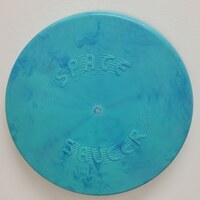
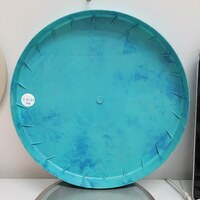
1957 Space Saucer
- Abstract
- Made in New Hampshire in 1957, the Space Saucer grew from the familiar practice of tossing household lids and pans. Ernest C. “Bill” Robes turned that idea into a plastic disc, sold it to college students, and wrote rules for a team game. His work reveals a separate East Coast path in the early history of the flying disc.
- Public Object History
-
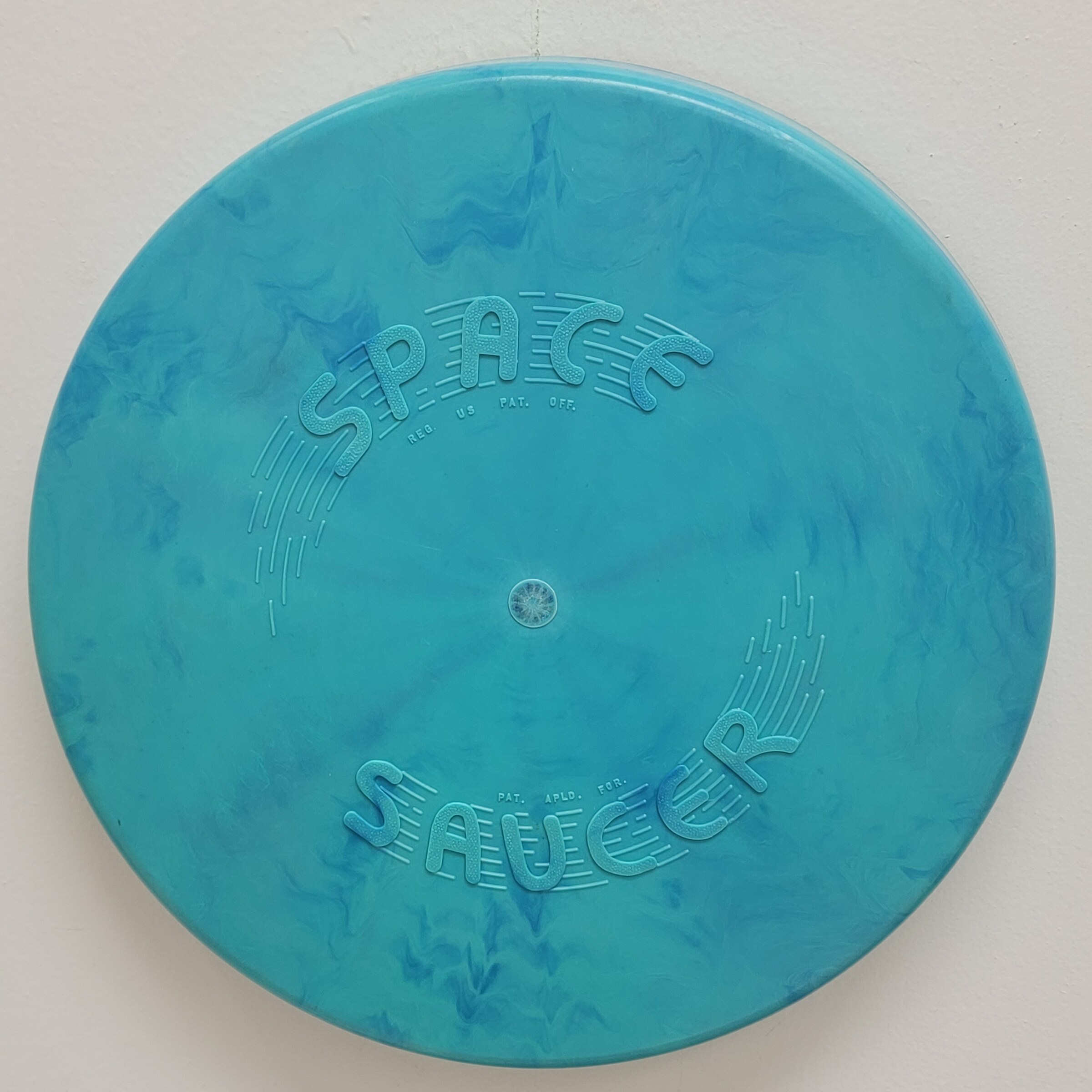
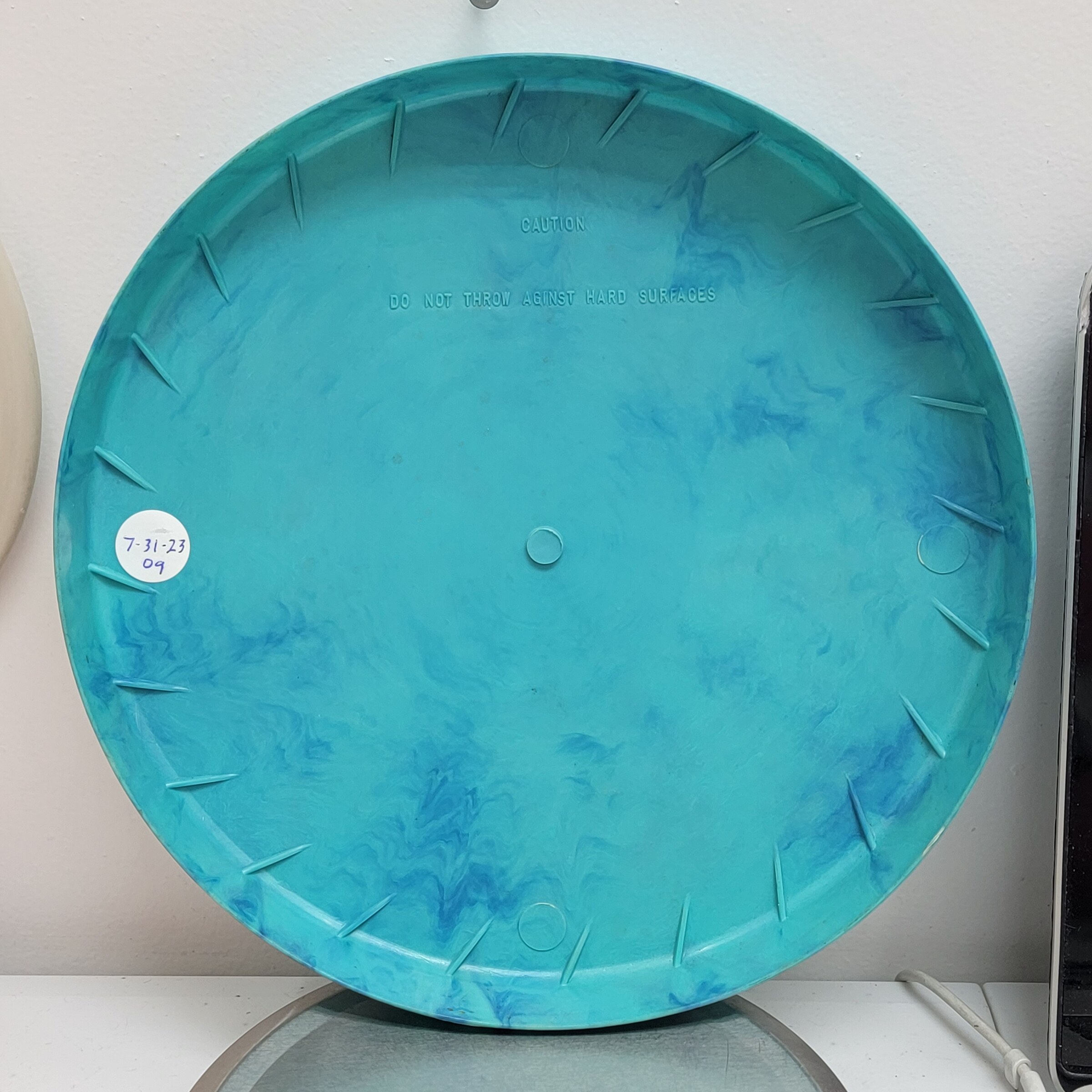
The Space Saucer looks simple: a shallow circle of turquoise plastic made to spin, glide, and be caught. Turn it over, however, and a ring of triangular ribs reveals a carefully molded structure. This 1957 SS12 preserves Ernest C. “Bill” Robes’s effort to turn familiar household forms into a repeatable flying toy—and to build a game and a business around it.
From a household shape to a manufactured flying disc
Before manufacturers sold plastic flying discs, people threw the circular objects already at hand. Pie tins, cake pans, and can lids could hold their shape, catch the air, and remain stable when spun. Robes began with that familiar material world, but he did not stop at repurposing an existing lid.
In a 1987 interview, Robes described an improvised development process. He molded plastics “in the shape of a tin can lid,” experimented with wooden forms, and heated sheets of Boltaron plastic on a kitchen stove. He shaped the softened plastic over an inverted washing-machine agitator and trimmed each piece by hand. The method was makeshift, but the goal was clear: produce a disc designed for throwing rather than borrow an object made for another purpose.
That transition gives the Space Saucer its place in the museum’s Origins Era. Its shape recalls the lids and pans of informal play, while its molded plastic body belongs to a new generation of objects manufactured specifically for flight.
Bill Robes and the work of making
Robes developed the Space Saucer in Etna, New Hampshire, during the early 1950s. He brought practical experience to the project. He made furniture, pursued several inventions, and was an acrobatic ski jumper who later taught skiing at Dartmouth and coached at Kimball Union Academy. The U.S. National Ski Hall of Fame inducted him in 1987.
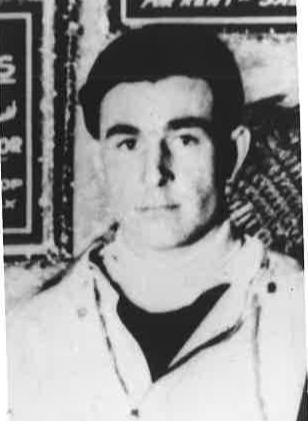 Ernest C. “Bill” Robes developed and produced the Space Saucer in Etna, New Hampshire.U.S. Ski & Snowboard Hall of Fame; image supplied by the National Disc Golf Museum director.
His skiing career does not explain the Space Saucer by itself. It does show a life shaped by motion, balance, materials, and hands-on problem solving. The early plastic experiments came from the same practical habit: try a form, observe what it does, and alter the way it is made.
Robes eventually moved from hand-forming plastic to injection molding. He recalled a production cycle that released one disc about every twenty-nine seconds. The museum’s SS12 belongs to that manufactured stage. Its underside ribs stiffen the body and distinguish the design from other flying discs of the period.
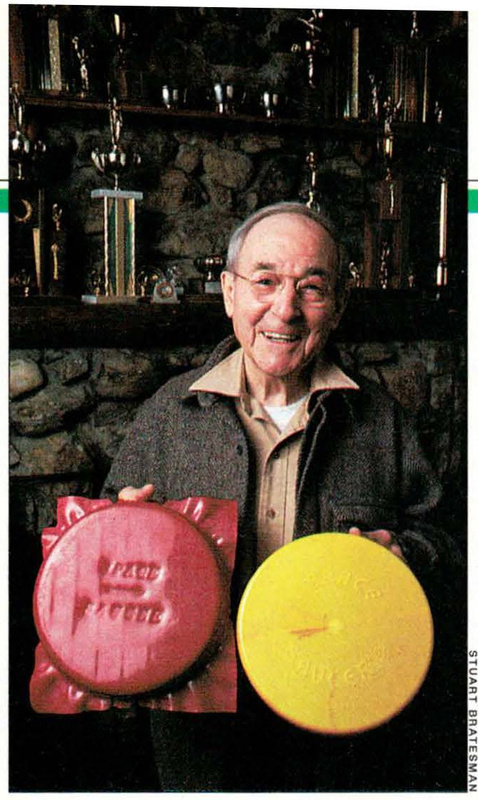 Robes with two Space Saucers in 1987. The surviving colors and forms hint at the product variations made during its commercial life.Photograph by Stuart Bratesman; Sports Illustrated, May 11, 1987.
From invention to organized play
A disc with rules for play
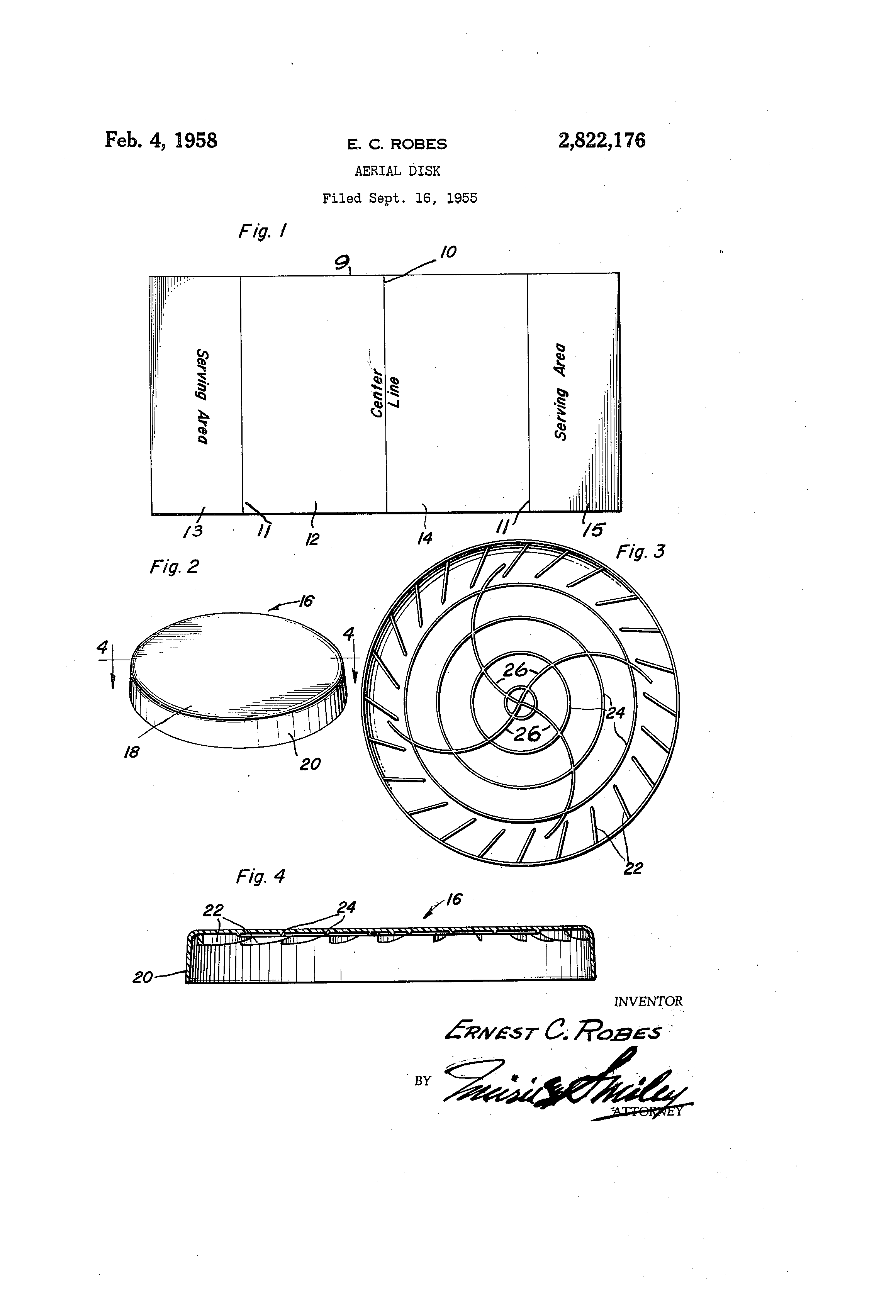
Robes treated the Space Saucer as both an object and a game. He filed a patent application for an “Aerial Disk” on September 16, 1955. The patent, granted on February 4, 1958, described the disc’s construction and outlined play between opposing teams on a divided field.
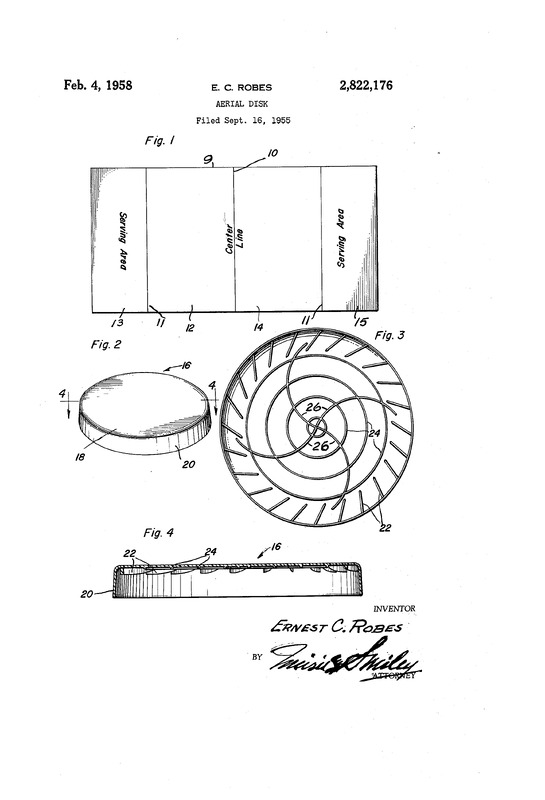 Robes’s patent joined the flying object to a game. Its first drawing sheet shows the Aerial Disk, its reinforced underside, and opposing serving areas. View the museum record.United States Patent Office, U.S. Patent 2,822,176, granted February 4, 1958.
Space Saucers sold for about fifty cents to Dartmouth students with game rules enclosed. Robes’s throwing game is related to the early development of Guts, in which opposing teams throw a disc toward one another and try to make a clean catch. The rules show that the Space Saucer was not merely a novelty to be tossed without purpose. Robes imagined repeated play, teams, boundaries, and competition.
College stores and regional circulation
College communities gave the Space Saucer its clearest market. A Yale Co-op advertisement published on May 10, 1957, promoted the New Hampshire disc by comparing it with the “Frisbie” already known in northeastern college culture. That advertisement places the Space Saucer inside a moment when students used a familiar name for several kinds of thrown objects and newly manufactured plastic discs.
A 1989 collectors’ article reported that Robes kept invoices documenting sales through the Dartmouth and Yale cooperative stores from 1954 to 1962. The National Disc Golf Museum has not yet examined those invoices, so that sales span remains an attributed account rather than a verified range. The surviving Yale advertisement independently confirms that the product reached a college retailer in 1957.
The national market that did not follow
Robes tried to move beyond regional sales. He later recalled that Parker Brothers proposed a royalty agreement, but he rejected the terms after a difficult meeting. Sports Illustrated reported his account in 1987 and noted that Parker Brothers could not verify the exchange. Robes also remembered another manufacturer considering the Space Saucer for a spring catalog, then declining to carry it.
Those negotiations mattered because a different commercial path was taking shape in California. Walter Frederick Morrison’s independently developed discs reached Wham-O, whose manufacturing, distribution, and promotion turned the Frisbee into a national product. That comparison helps explain the Space Saucer’s history, but it does not make Robes’s work a branch of Morrison’s. The two inventors worked separately and produced different designs.
Why production ended
Robes ceased production in 1962. Sports Illustrated reported that he had sold about 65,000 Space Saucers and still held substantial inventory. No reviewed source identifies one decision or event that ended the venture. The record instead shows a viable regional product that failed to secure the national manufacturing agreement Robes sought.
Reading this Space Saucer
The museum’s example weighs approximately 90 grams. Its turquoise plastic, shallow profile, and reinforced underside make the shift from improvised household object to purpose-built product visible. The SS12 is not simply evidence that people threw discs in the 1950s. It records decisions about material, stiffness, production speed, organized play, and how a new object might be sold.
The Space Saucer stands at the boundary between the museum’s Flying Saucer and Toy sub-eras. Its name belongs to the postwar fascination with flying saucers; its continued production through 1962 overlaps the period when Frisbee became the dominant commercial identity. This surviving disc keeps another route into flying-disc history in view: an East Coast inventor, college players, a patented game, and a promising product that never became the familiar name.
- Identifier
- L.FD003A
- Type
- Flying disc
- Date
- 1957
- Medium
- Plastic; turquoise
- Extent
- 90 g
- Provenance
- Evolution of the Flying Disc
- On Display In
- History of Flying Discs
- Sources and References
- Mark Danna, “After 30 High-Flying Years, the Frisbee Still Soars,” Sports Illustrated, May 11, 1987
- Flying Disc Museum, “Space Saucers”
- Flying Disc Museum, “A Timeline of Events in the History of the Flying Disc”
- “The Ernest C. Robes Space Saucer: an early 1950’s disc,” Discovering the World, Winter 1989, p. 45
- Judith Ann Schiff, “The Frisbee Files,” Yale Alumni Magazine, May/June 2007
- U.S. Patent 2,822,176, “Aerial Disk,” Ernest C. Robes, filed September 16, 1955; granted February 4, 1958
- U.S. Design Patent D183,626, “Flying Toy,” Walter Frederick Morrison, filed July 22, 1957; granted September 30, 1958
- U.S. Ski & Snowboard Hall of Fame, “Ernest C. Robes”
- Physical Display Status
- On display
- CollectiveAccess Object ID
- 78
- Label text
- my sign text
- Item sets
- Evolution of the Flying Disc